Introduction: Why SEO Matters More Than Ever
If you’re a non-technical founder or entrepreneur in the US, you’ve probably heard the term SEO & Keywords thrown around many times. Some say it’s essential. Others say it’s dead. The truth lies somewhere in between—and in 2026, SEO is evolving faster than ever.
With AI tools answering questions directly and search behavior changing, SEO today is no longer just about ranking on Google. It’s about being discoverable everywhere—search engines, AI assistants, and local results.
This is where understanding SEO & keywords , and GEO becomes critical for any business investing in digital marketing services.
What Is SEO (Search Engine Optimization)?
SEO stands for Search Engine Optimization. In simple terms, it’s the process of optimizing your website so that people can find you organically when they search online.
SEO focuses on three core areas:
- Technical SEO – how your website is built and performs
- On-page SEO – content, keywords, and structure
- Off-page SEO – authority, trust, and signals from outside your site
Unlike paid ads, SEO is not about instant visibility. It’s about building long-term, sustainable traffic that continues to bring leads even when you’re not actively spending money.
What Are Keywords and Why Are They Important?
Keywords are the words and phrases people type—or speak—when searching online.
For example:
- “digital marketing services for small business”
- “web design company in the US”
- “how does SEO work?”
Keywords act as a bridge between what people are searching for and the content you create.
However, modern SEO is not about stuffing keywords everywhere. Search engines and AI tools now focus on intent, context, and usefulness.
The real question founders should ask is:
Are we answering the right questions our customers are already asking?
How SEO and Keywords Actually Work Together
SEO works when keywords are used strategically—not aggressively.
Here’s how it flows:
- A user searches for a problem or question
- Search engines analyze intent
- They look for pages that clearly, helpfully answer that intent
- Websites with strong structure, relevance, and authority surface higher
Keywords help search engines and AI systems understand:
- What your page is about
- Who it’s for
- When it should appear in results
This is why SEO today is more content-driven and experience-driven than ever before.
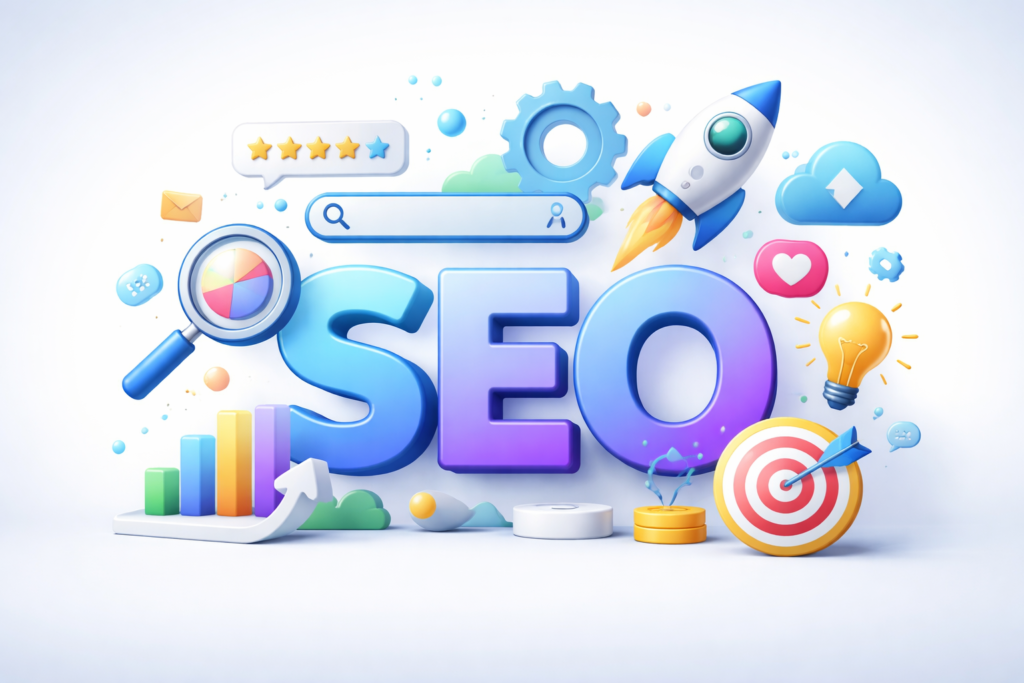
The Role of GEO (Generative Engine Optimization)
This is where SEO is changing.
GEO (Generative Engine Optimization) focuses on optimizing content so it can be understood, trusted, and referenced by AI tools like ChatGPT, Gemini, and Perplexity.
Instead of ranking for one keyword, GEO focuses on:
- Clear explanations
- Structured content
- Human-like answers
- Authority and clarity
In short:
- SEO helps you rank
- GEO helps you get recommended
Founders who ignore GEO risk becoming invisible in AI-driven search experiences.
SEO vs Paid Ads: What Founders Should Know
Many founders ask:
Should I invest in SEO or paid ads?
The honest answer: they serve different purposes.
Paid ads:
- Deliver immediate traffic
- Stop the moment you stop paying
SEO:
- Takes time
- Builds compounding visibility
- Supports AI and organic discovery
For most growing businesses, SEO becomes the foundation, while paid ads amplify results.
How SEO Connects with Web Design
SEO does not work in isolation.
Your web design directly impacts:
- Page speed
- Mobile experience
- Content structure
- User engagement
A visually beautiful website that loads slowly or confuses users will struggle to rank—no matter how good the keywords are.
This is why modern digital marketing services treat SEO and web design as one system, not two separate tasks.
Common SEO Myths Non-Technical Founders Believe
Let’s clear a few common misconceptions:
- “SEO is a one-time task” – It’s ongoing
- “More keywords = better ranking” – Quality beats quantity
- “SEO results should be instant” – Real SEO compounds
- “AI killed SEO” – AI actually makes good SEO more valuable
Understanding these myths helps founders set realistic expectations.
What a Realistic SEO Strategy Looks Like in 2026
A modern SEO strategy includes:
- Intent-based keyword research
- High-quality, helpful content
- SEO-friendly web design
- GEO-ready content structure
- Performance and UX optimization
- Continuous improvement
SEO is no longer about gaming algorithms—it’s about serving users better than competitors.
Final Thoughts
SEO and keywords are not technical mysteries meant only for experts. When understood correctly, they become powerful growth tools for founders who want consistent visibility and trust.
At GearUp Code, we approach SEO as part of a larger digital growth strategy—combining web design, SEO, GEO, and digital marketing services into one clear, founder-friendly system.
If you want SEO that aligns with your business goals—not just rankings—GearUp Code can help you build a future-ready SEO and GEO strategy without technical overwhelm.