Introduction
As the world continues to become more digitally connected, mobile applications have become an essential part of businesses’ strategies to engage with customers. When it comes to building a mobile app, companies and developers often face the dilemma of choosing between Hybrid vs Native App Development.
In 2026, app development continues to evolve with new tools, frameworks, and market demands. Understanding the differences between hybrid and native apps is crucial for businesses that want to provide the best user experience (UX), performance, and scalability.
In this blog post, we will explore the key differences between hybrid and native apps, their advantages and disadvantages, and how to choose the right path for your app development needs.
What is Native App Development?
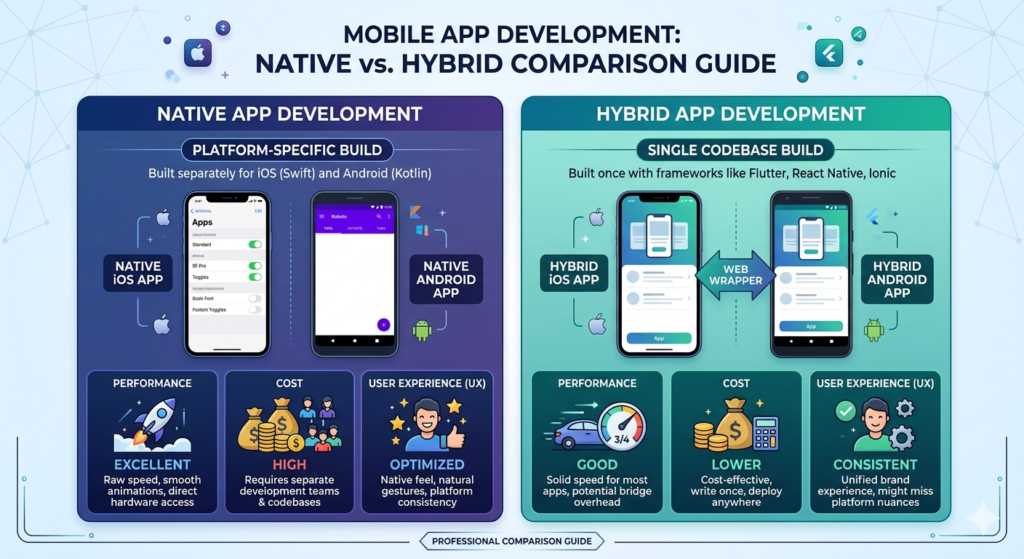
Native apps are designed and developed for specific mobile operating systems, such as iOS (using Swift or Objective-C) and Android (using Java or Kotlin). These apps are installed directly on the user’s device and can leverage all the hardware and software features of the platform.
Advantages of Native App Development:
- Performance: Native apps generally offer better performance because they are optimized for the platform they are built for.
- Full Access to Device Features: Native apps have access to device features like the camera, GPS, microphone, and sensors, providing a richer user experience.
- Best UI/UX: Native apps offer the best user experience by using platform-specific design patterns and interface elements.
- App Store Optimization: Native apps are listed in their respective app stores (Google Play or Apple App Store) and can take full advantage of store features like in-app purchases, notifications, and ratings.
Disadvantages of Native App Development:
- Higher Cost: Developing separate native apps for iOS and Android can be expensive and time-consuming.
- Longer Development Time: Native app development requires building two separate codebases for different platforms, leading to longer development cycles.
- Maintenance: Updating and maintaining two separate apps can be more complex and require more resources.
What is Hybrid App Development?
Hybrid apps are a combination of native and web applications. They are built using web technologies like HTML, CSS, and JavaScript, but are packaged inside a native container. This allows the app to be deployed on multiple platforms using a single codebase. Hybrid apps are typically developed using frameworks like React Native, Flutter, and Ionic.
Advantages of Hybrid App Development:
- Cross-Platform Compatibility: Hybrid apps allow businesses to use a single codebase to run on both iOS and Android, making them cost-effective and efficient.
- Faster Development: With a shared codebase, hybrid apps are generally quicker to develop and deploy across multiple platforms.
- Lower Development Cost: Hybrid apps reduce development costs since businesses do not need to develop two separate apps for different platforms.
- Access to Native Features: Hybrid apps can still access many of the device’s native features, like the camera, GPS, and accelerometer, using plugins or native modules.
Disadvantages of Hybrid App Development:
- Performance Limitations: Hybrid apps may not perform as well as native apps, especially for resource-intensive applications like games or apps requiring complex animations.
- User Experience: While hybrid apps can mimic the native look and feel, they may not always match the performance and fluidity of native apps, potentially affecting the UX.
- Platform Limitations: Some advanced features of native platforms might not be available in hybrid apps, or they may require additional custom development.
Key Differences Between :- Hybrid vs Native App Development
| Feature | Native App Development | Hybrid App Development |
| Platform | iOS or Android only | Cross-platform (iOS + Android) |
| Development Cost | Higher (two codebases for two platforms) | Lower (single codebase for all platforms) |
| Development Speed | Slower (requires separate development for each platform) | Faster (single codebase) |
| Performance | Best performance (native APIs) | Slower performance (webview integration) |
| User Experience | Best UX (platform-specific) | Limited by webview (can mimic but may not feel as smooth) |
| Access to Device Features | Full access to device features | Limited access (requires plugins) |
| Maintenance | More complex (two apps to maintain) | Easier (single codebase) |
When to Choose Native App Development
- Performance-Intensive Apps: If your app requires high performance, such as in gaming, video editing, or other graphics-heavy applications, native app development is the best choice.
- Platform-Specific Features: If you want to take full advantage of iOS or Android features, such as complex camera functions, gestures, or advanced GPS capabilities, native apps will provide superior access to these features.
- Best User Experience: If offering the best possible UX and making a fully optimized app for your platform is your top priority, native development is the way to go.
- Long-Term Projects: If you have a long-term app with continuous updates, native apps are ideal because they provide stability and high performance as you scale.
When to Choose Hybrid App Development
- Budget and Time Constraints: If your business has limited resources for development and you need to launch the app quickly, hybrid app development is the right choice. With one codebase, you can save both time and money.
- MVPs and Prototypes: For startups or businesses testing new ideas, a hybrid app can be a good choice for creating a Minimum Viable Product (MVP) that can later be upgraded into a native app based on user feedback.
- Cross-Platform Reach: If you want to launch your app on both iOS and Android without building two separate codebases, hybrid development offers a practical solution.
- Apps with Moderate Complexity: Hybrid apps are ideal for apps that do not require advanced device features or heavy computation. Apps like news apps, social media apps, or productivity tools can work well as hybrid apps.
Choosing the Right Path for Your App in 2026
As we move into 2026, the decision between native and hybrid app development depends largely on your business needs, budget, and long-term goals. Both options offer their own set of benefits and challenges.
- Native app development is perfect for businesses that need high performance, advanced features, and top-tier user experience.
- Hybrid app development, on the other hand, is ideal for businesses with limited budgets or those who need to reach multiple platforms quickly.
At GearUp Code, we specialize in both native and hybrid app development and can help you choose the right approach for your business. Our team of experts ensures that your mobile app is built to meet your business objectives, deliver an exceptional user experience, and scale as your business grows.