Introduction: Why URL Changes Can Make or Break SEO
Changing URLs is sometimes unavoidable—whether you’re redesigning your website, migrating to a new domain, or improving site structure. However, even a small URL change can significantly impact SEO rankings, traffic, and user experience if not handled correctly.
In this article, we’ll explain how changing URLs affects SEO, common risks, and best practices for redirects, URL structure, and website migration—so your rankings stay protected.
This is why URL planning is a critical part of professional digital marketing services and SEO strategy.
What a URL Really Means for SEO
A URL is more than just a web address. Search engines use URLs to understand:
- Page topic and relevance
- Site structure and hierarchy
- Relationships between pages
- Crawl and indexing paths
Clean, descriptive URLs help both users and search engines understand what a page is about—before they even read the content.
When and Why Businesses Change URLs
URL changes usually happen during:
- Website redesigns
- Platform migrations (e.g., moving to WordPress)
- Rebranding or restructuring services
- SEO cleanup projects
- Content consolidation
While these changes are often necessary, they must be handled with care to protect existing SEO value.
How Changing URLs Affects SEO Performance
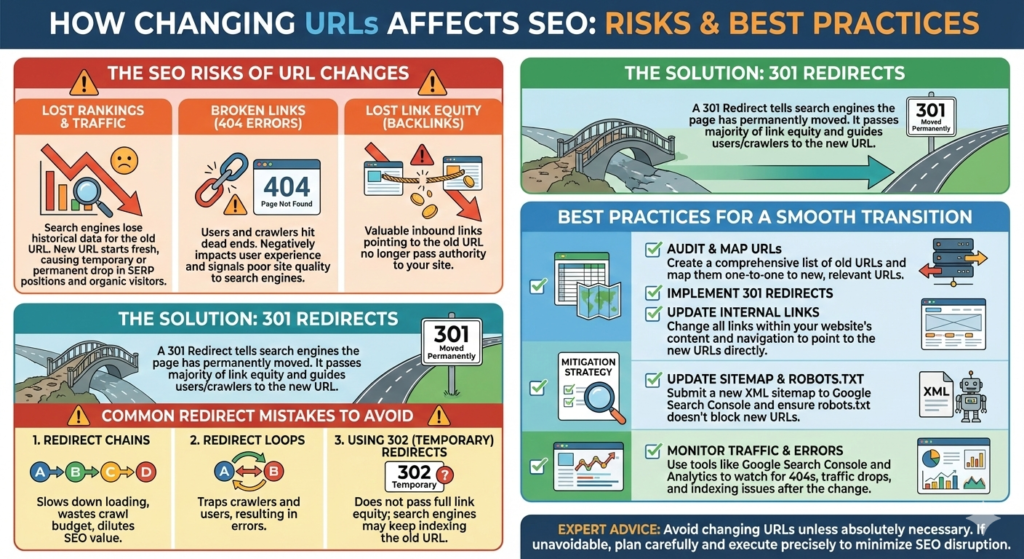
When a URL changes, search engines treat it as a new page unless properly redirected, which clearly explains how changing URLs affects SEO and why rankings can drop without the right strategy.
Potential impacts include:
- Temporary or permanent ranking drops
- Loss of backlinks
- Crawl errors
- Reduced AI and GEO visibility
Without a clear redirect strategy, years of SEO effort can be lost overnight.
Redirects Explained: What Works and What Hurts
Redirects tell search engines and users that a page has moved.
301 Redirects (Best Practice)
- Permanent redirect
- Passes most SEO value
- Recommended for URL changes
302 Redirects (Use Carefully)
- Temporary redirect
- SEO value may not fully transfer
Best practice is to use 301 redirects whenever URLs change permanently.
Poor redirect setups—such as redirect chains or missing redirects—can seriously harm performance.
Best Practices for URL Structure in 2026
Modern URL structure should be:
- Short and readable
- Keyword-relevant (without stuffing)
- Consistent across the site
- Aligned with content hierarchy
A good URL supports SEO, GEO, and user trust at the same time.
SEO-Safe Website Migration: What Founders Should Know
Website migration is one of the highest-risk SEO activities.
A proper migration plan includes:
- URL mapping (old → new)
- 301 redirect implementation
- Crawl and performance testing
- Post-migration monitoring
This is where many businesses choose to get expert SEO services from GearUp Code — on-page, off-page & technical SEO to boost rankings, traffic and visibility for your business.
Professional oversight ensures that SEO equity is preserved during transitions.
Common URL & Migration Mistakes to Avoid
Some of the most common mistakes include:
- Changing URLs without redirects
- Blocking pages accidentally
- Ignoring internal links
- Not updating sitemaps
- Launching without testing
These errors are avoidable with proper planning and execution.
How URL Changes Connect with Web Design & UX
Changing URLs often happen alongside web design updates.
A well-structured website:
- Improves navigation
- Supports SEO-friendly URLs
- Helps AI systems understand page relationships
- Enhances user experience
SEO and web design should always move together—not separately.
Final Thoughts
Changing URLs is not inherently bad for SEO—but doing it without a strategy is. Understanding how changing URLs affects SEO allows you to plan updates correctly, avoid ranking losses, and protect your organic traffic.
With the right redirects, clean URL structure, and proper planning, URL changes can actually strengthen your SEO foundation and future-proof your website.
At GearUp Code, we handle URL changes and migrations with precision—protecting your rankings while supporting growth.