
Every business operates differently.
Yet many companies still rely on generic software that forces them to adjust their workflow. That approach slows growth and limits efficiency.
Custom software development changes that.
If you want technology that fits your business instead of restricting it, you need to understand how custom software works and why it matters.
Let’s break it down in simple terms.
Introduction
Custom software development means building software tailored specifically to your business needs.
Unlike off-the-shelf tools, custom solutions align with your goals, processes, and customer requirements.
In 2026, businesses demand flexibility, automation, and scalability. Custom software provides all three.
Understanding the basics helps you decide whether this investment makes sense for your organization.
What Is Custom Software Development?
Custom software development involves designing, building, deploying, and maintaining software created for a specific company.
Developers analyze your workflow, identify challenges, and build a system that solves those problems directly.
Examples include:
- Custom CRM systems
- Inventory management tools
- Business automation platforms
- Mobile applications
- SaaS platforms
Instead of adapting your business to software, the software adapts to you.
How Custom Software Differs from Off-the-Shelf Solutions
Off-the-shelf software serves a broad audience.
Custom software serves you.
Here is the key difference:
| Off-the-Shelf Software | Custom Software |
| Limited flexibility | Fully tailored |
| Generic features | Business-specific features |
| Shared infrastructure | Dedicated architecture |
| Subscription-based | Long-term asset |
Custom solutions give you full control over features, security, and performance.
Why Businesses Choose Custom Software in 2026
Modern businesses face unique challenges.
Standard tools often include unnecessary features while missing critical ones.
Companies choose custom software because it:
- Improves operational efficiency
- Automates repetitive tasks
- Enhances data security
- Scales with growth
- Integrates with existing systems
Custom solutions create a competitive advantage.
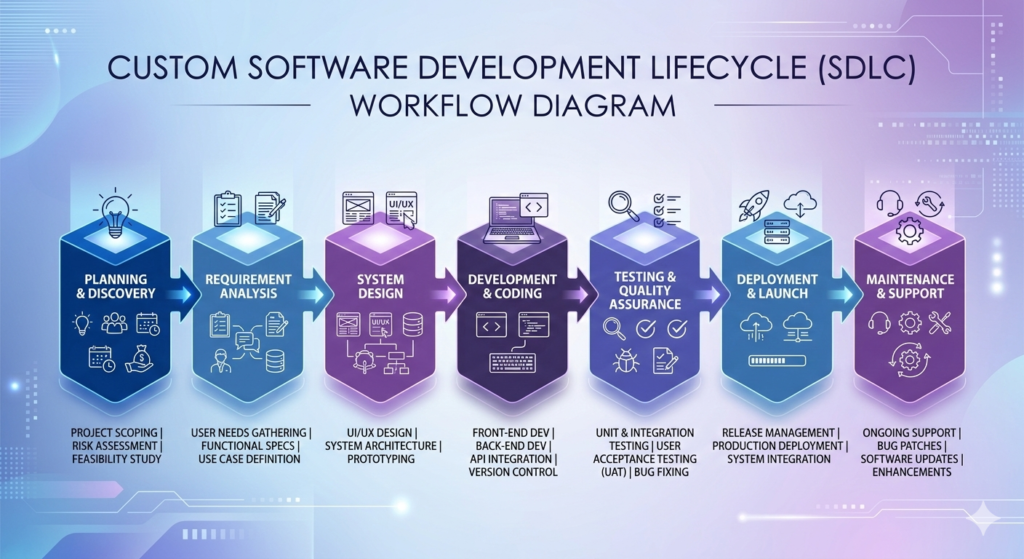
Key Stages of Custom Software Development
Understanding the development process helps you plan better.
1. Requirement Analysis
Developers gather information about your business goals, workflows, and pain points.
Clear requirements ensure accurate development.
2. Planning and Strategy
The team defines the technology stack, timeline, and project scope.
Proper planning reduces risks.
3. UI/UX Design
Designers create user-friendly interfaces and system architecture.
Good design improves adoption and productivity.
4. Development
Developers write code based on approved designs.
They build features step by step.
5. Testing and Quality Assurance
Testing ensures the software functions properly and securely.
Teams fix bugs before launch.
6. Deployment
Developers launch the software on your chosen platform.
Deployment includes server configuration and optimization.
7. Maintenance and Updates
Software requires ongoing improvements and security updates.
Maintenance keeps your system stable and scalable.
Benefits of Custom Software Development
Custom software offers long-term business value.
1. Increased Efficiency
Automation reduces manual work.
Teams complete tasks faster.
2. Better Security
Custom-built systems minimize exposure to common vulnerabilities.
Developers design security measures specifically for your infrastructure.
3. Scalability
As your business grows, your software grows with it.
Developers can add features anytime.
4. Competitive Advantage
Unique tools help you outperform competitors using generic systems.
5. Seamless Integration
Custom solutions integrate with your CRM, ERP, accounting tools, and APIs smoothly.
Practical Use Cases
Custom software works across industries.
E-commerce
Build personalized shopping platforms and inventory systems.
Healthcare
Develop secure patient management systems.
Logistics
Create route optimization and fleet tracking tools.
Education
Design custom learning management platforms.
Every industry benefits from tailored technology.
How to Decide If You Need Custom Software
Ask yourself these questions:
- Does your current software limit productivity?
- Do you use multiple disconnected tools?
- Do you need specific features unavailable elsewhere?
- Do you want to scale operations efficiently?
If you answered yes to any of these, custom software may be the right solution.
Common Mistakes to Avoid
Many businesses make avoidable errors.
1. Unclear Requirements
Vague goals cause project delays.
2. Choosing Cost Over Quality
Cheap development often leads to long-term issues.
3. Ignoring Scalability
Design your system for future growth.
4. Skipping Maintenance Planning
Software needs regular updates.
5. Poor Communication
Maintain constant collaboration with your development team.
Avoiding these mistakes ensures project success.
Future Trends in Custom Software Development
Technology evolves rapidly.
In 2026, expect growth in:
- AI-powered automation
- Cloud-native applications
- Low-code integration
- API-first architecture
- Advanced cybersecurity protocols
Businesses that adopt modern development strategies stay ahead.
Custom software enables innovation without limitations.
Cost Considerations
Custom software requires upfront investment.
However, it reduces long-term subscription costs and inefficiencies.
Pricing depends on:
- Project complexity
- Features required
- Technology stack
- Development timeline
Instead of viewing it as an expense, consider it a long-term asset.
Conclusion
Custom software development empowers businesses with tailored solutions that drive efficiency and growth.
It eliminates limitations of generic systems and provides full control over features, performance, and security.
If your business needs flexibility, automation, and scalability, custom software offers the perfect solution.
Invest in technology that supports your vision.
Partner with GearUp Code to build powerful, scalable, and secure custom software tailored to your business goals.